
Ford Fusion: Fuel Tank and Lines - 1.5L EcoBoost (118kW/160PS) – I4 / Fuel Lines. Removal and Installation
Ford Fusion 2013–2020 Service Manual / Powertrain / Fuel System - General Information / Fuel Tank and Lines - 1.5L EcoBoost (118kW/160PS) – I4 / Fuel Lines. Removal and Installation
Removal
NOTE: Removal steps in this procedure may contain installation details.
-
Refer to: Gasoline and Gasoline-Ethanol Fuel Systems Health and Safety Precautions (100-00 General Information, Description and Operation). WARNING:
Before beginning any service procedure in this
section, refer to Safety Warnings in section 100-00 General Information.
Failure to follow this instruction may result in serious personal
injury.
WARNING:
Before beginning any service procedure in this
section, refer to Safety Warnings in section 100-00 General Information.
Failure to follow this instruction may result in serious personal
injury.
-
Remove the Fuel Tank.
Refer to: Fuel Tank (310-01A Fuel Tank and Lines - 1.5L EcoBoost (118kW/160PS) – I4, Removal and Installation).
-
-
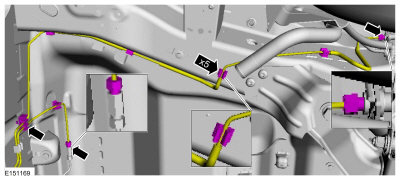
Disconnect the brake lines.
Torque: 133 lb.in (15 Nm)
-
Disconnect the electrical connector and fuel line retainer.
-
Disconnect the brake lines.
 |
-
-
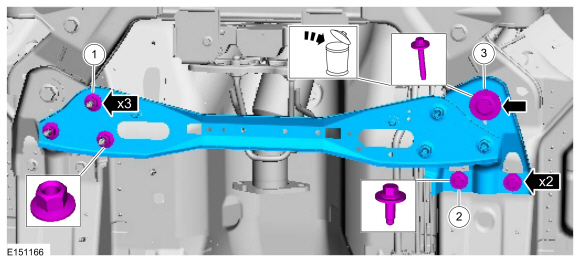
Remove the nuts.
Torque: 33 lb.ft (45 Nm)
-
Remove the bolts.
Torque: 44 lb.ft (60 Nm)
-
NOTE: Discard the specified component. Follow local disposal regulations.
Remove the bolt and the cross member.
Torque:
Stage 1: 76 lb.ft (103 Nm)
Stage 2: 270°
-
Remove the nuts.
 |
-
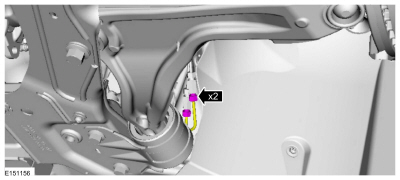
Disconnect the brake lines.
Torque: 133 lb.in (15 Nm)
 |
-
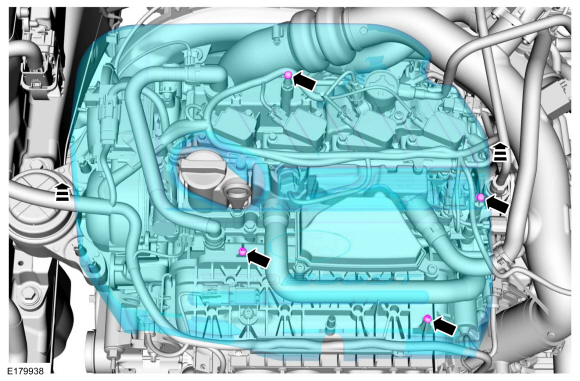
Remove the engine cover.
 |
-
Remove the Air Cleaner Outlet Pipe.
Refer to: Air Cleaner Outlet Pipe (303-12A Intake Air Distribution and Filtering - 1.5L EcoBoost (118kW/160PS) – I4, Removal and Installation).
-
NOTE: Some residual fuel may remain in the fuel tubes after releasing the fuel system pressure. When disconnecting or removing any fuel tubes, carefully drain any residual fuel into a suitable container.
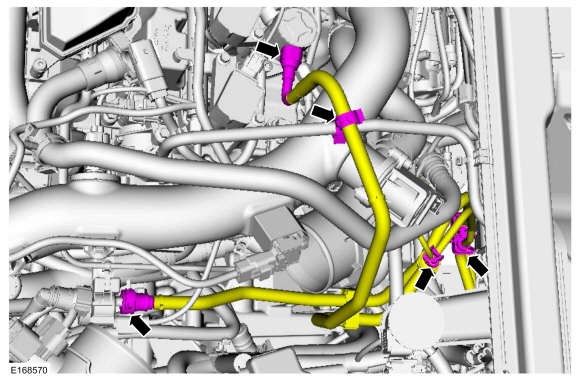
Disconnect the quick release couplings.
Refer to: Quick Release Coupling (310-00A Fuel System - General Information - 1.5L EcoBoost (118kW/160PS) – I4, General Procedures).
 |
-
-
Disconnect the fuel line retainer.
-
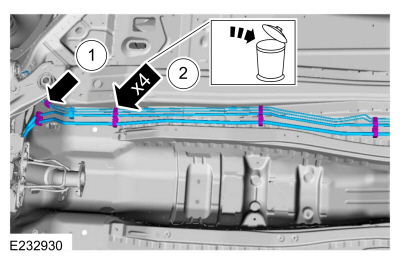
Disconnect and discard the fuel line retainers
attaching to underbody. Remove the fuel lines from the vehicle.
-
Disconnect the fuel line retainer.
 |
Installation
-
To install, reverse the removal procedure.
-
Bleed the brake system.
Refer to: Brake System Pressure Bleeding (206-00 Brake System - General Information, General Procedures).
 Fuel Tank and Lines - Overview. Description and Operation
Fuel System
NOTICE:
Repairs of the fuel system are to be achieved only by
replacement of the failed component(s). Repair of a fuel system
component should not be attempted...
 Fuel Pump and Sender Unit. Removal and Installation
Special Tool(s) /
General Equipment
310-123Locking Ring, Fuel TankTKIT-2004J-FTKIT-2005U-LM
Removal
NOTE:
Removal steps in this procedure may contain installation details...
Other information:
Ford Fusion 2013–2020 Service Manual: Rear Brake Flexible Hose. Removal and Installation
Removal NOTICE: Do not spill brake fluid on painted or plastic surfaces or damage to the surface may occur. If brake fluid is spilled onto a painted or plastic surface, immediately wash the surface with water. NOTE: Removal steps in this procedure may contain installation details...
Ford Fusion 2013–2020 Service Manual: Intake Air Temperature (IAT) Sensor. Removal and Installation
Removal NOTE: Removal steps in this procedure may contain installation details. Disconnect the IAT sensor electrical connector and remove the IAT sensor. Installation To install, reverse the removal procedure...
Categories
- Manuals Home
- 2nd Generation Ford Fusion Owners Manual
- 2nd Generation Ford Fusion Service Manual
- Under Hood Overview - 1.5L EcoBoost™, 2.0L EcoBoost™, 2.5L, 2.7L EcoBoost™
- Cylinder Head Temperature (CHT) Sensor. Removal and Installation
- Starter Motor. Removal and Installation
- New on site
- Most important about car
Power Door Locks
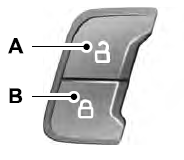
The power door lock control is on the driver and front passenger door panels.

Copyright © 2026 www.fofusion2.com