
Ford Fusion: Roadside Emergencies / Jump Starting the Vehicle
WARNING: Batteries normally produce explosive gases which can cause personal injury. Therefore, do not allow flames, sparks or lighted substances to come near the battery. When working near the battery, always shield your face and protect your eyes. Always provide correct ventilation.
WARNING: Keep batteries out of reach of children. Batteries contain sulfuric acid. Avoid contact with skin, eyes or clothing. Shield your eyes when working near the battery to protect against possible splashing of acid solution. In case of acid contact with skin or eyes, flush immediately with water for a minimum of 15 minutes and get prompt medical attention. If acid is swallowed, call a physician immediately.
WARNING: Use only adequately sized cables with insulated clamps.
Preparing Your Vehicle
Do not attempt to push-start your automatic transmission vehicle.
Note: Attempting to push-start a vehicle with an automatic transmission may cause transmission damage.
Note: Use only a 12-volt supply to start your vehicle.
Note: Do not disconnect the battery of the disabled vehicle as this could damage the vehicle electrical system.
Park the booster vehicle close to the hood of the disabled vehicle, making sure the two vehicles do not touch.
Connecting the Jumper Cables
WARNING: Do not connect the end of the second cable to the negative (-) terminal of the battery to be jumped. A spark may cause an explosion of the gases that surround the battery.
WARNING: Do not use fuel lines, engine valve covers, windshield wiper arms, the intake manifold, or hood latch as ground points.
Note: Do not attach the end of the positive cable to the studs or L-shaped eyelet located above the positive (+) terminal of your vehicle’s battery. High current may flow through and cause damage to the fuses.
Note:To avoid reverse polarity connections, make sure that you correctly identify the positive (+) and negative (-) terminals on both the disabled and booster vehicles before connecting the cables.
Note: Remove the red cap from the positive prong (B) on your vehicle before connecting the cables.
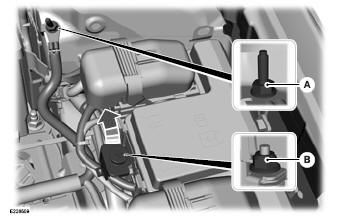
- Negative prong (–).
- Positive prong (+).
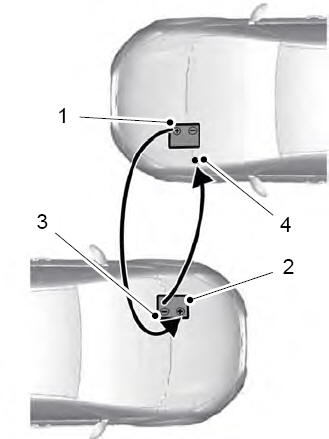
Note: In the illustration, the bottom vehicle represents the booster vehicle.
- Connect the positive (+) jumper cable to the positive (+) terminal of the discharged battery.
- Connect the other end of the positive (+) cable to the positive (+) terminal of the booster vehicle battery.
- Connect the negative (-) cable to the negative (-) terminal of the booster vehicle battery.
- Make the final connection of the negative (-) cable to an exposed metal part of the stalled vehicle's engine, away from the battery and the fuel injection system, or connect the negative (-) cable to a ground connection point if available.
Jump Starting
- Start the engine of the booster vehicle and rev the engine moderately, or press the accelerator gently to keep your engine speed between 2000 and 3000 RPM, as shown in your tachometer.
- Start the engine of the disabled vehicle.
- Once the disabled vehicle has been started, run both vehicle engines for an additional three minutes before disconnecting the jumper cables.
Removing the Jumper Cables
Remove the jumper cables in the reverse order that they were connected.
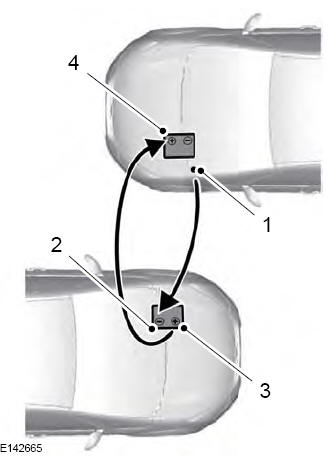
- Remove the negative (-) jumper cable from the disabled vehicle.
- Remove the jumper cable on the negative (-) terminal of the booster vehicle battery.
- Remove the jumper cable from the positive (+) terminal of the booster vehicle battery.
- Remove the jumper cable from the positive (+) terminal of the disabled vehicle battery.
- Allow the engine to idle for at least one minute.
 Hazard Flashers. Fuel Shutoff
Hazard Flashers
Note: The hazard flashers operate when
the ignition is in any position, or if the key is
not in the ignition. If used when the vehicle
is not running, the battery loses charge...
 Post-Crash Alert System. Transporting the Vehicle
Post-Crash Alert System
The system flashes the direction indicators
and sounds the horn (intermittently) in the
event of a serious impact that deploys an
airbag (front, side, side curtain or Safety
Canopy) or the seatbelt pretensioners...
Other information:
Ford Fusion 2013–2020 Service Manual: Transport Mode Deactivation. General Procedures
Deactivation NOTE: After vehicle build, some vehicle modules are set in Transport mode including the IPC and the BCM. Transport mode reduces battery drain during longer periods where the vehicle is not used. While in transport mode, the IPC displays TRANSPORT MODE CONTACT DEALER in the message center...
Ford Fusion 2013–2020 Service Manual: Front Impact Severity Sensor. Removal and Installation
Removal NOTE: Removal steps in this procedure may contain installation details. WARNING: Turn the ignition OFF and wait one minute to deplete the backup power supply. Ignition must remain OFF until repair is complete. Failure to follow this instruction may result in serious personal injury or death in the event of an accidental deployment...
Categories
- Manuals Home
- 2nd Generation Ford Fusion Owners Manual
- 2nd Generation Ford Fusion Service Manual
- Engine
- Engine - 1.5L EcoBoost (118kW/160PS) – I4
- Traction Control
- New on site
- Most important about car
Cross Traffic Alert System Sensors
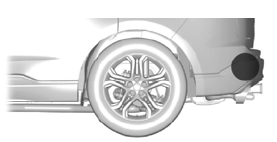
The sensors are behind the rear bumper on both sides of your vehicle.
